Polyimide (PI) Stiffener (FPS) - for FPC Reinforcement Engineered for High Bonding Strength, Structural Integrity, and Long-Term Reliability
Product Description:
Polyimide (PI) stiffener FPS is a common and important requirement for a flexible PCB to bolster the rigidity of specific areas of flex or rigid-flex circuits by improving their durability and reliability. It is a mechanical support part or heat dissipation element, which significantly influences the reliability of flexible printed circuits, and it can be bonded on one or two sides of the specific areas of flex.
Our PI stiffener (FPS ) is made up of our high dimensional stability polyimide film and a high bonding strength thermosetting epoxy adhesive TSA - room temperature type. It is specifically engineered for direct FPC reinforcement, utilizing thermosetting adhesive (TSA) systems to deliver significantly higher bonding strength than conventional PSA-based stiffeners.
It is most commonly applied in the area on the back of the FPC golden fingers, which will be inserted into the ZIF connector. It can also be used as a substrate for FPC to protect delicate components from damage due to handling and mechanical stresses. Our FPS provides excellent solder resistance and high bonding strengths with PET, FR4, PI, and PCB. It is an ideal solution in many designs for improving the durability and reliability of the flex circuits.
Engineering Challenges in FPC Reinforcement
In practical FPC applications, reinforcement failures are often caused by adhesion limitations rather than material stiffness, especially when using PSA-based stiffeners.
Common challenges include:
Insufficient bonding strength between stiffener and FPC substrate
Delamination under repeated bending or flexural stress
Adhesive creep or peel-off during thermal cycling
Loss of positional stability in reinforced areas
Reduced long-term reliability in mechanically demanding environments
These issues become critical in thin FPC designs, where mechanical loads are transferred directly through the adhesive interface.
Our PI Stiffener FPS Approach
Our PI Stiffener (FPS) solutions are engineered with a primary focus on bonding integrity and structural reliability, featuring:
TSA-based adhesive system
Providing significantly higher bonding strength than PSA for demanding FPC applications
Stable adhesion under flexural and thermal stress
Maintaining reinforcement integrity during repeated bending and temperature cycling
Uniform stress transfer across the bonded interface
Reducing localized peel stress and delamination risk
Compatibility with thin and complex FPC layouts
Supporting compact designs without excessive thickness buildup
Unlike PSA-based reinforcement, FPS is designed to become an integrated structural part of the FPC, not a removable or stress-sensitive attachment.
How our PI Stiffener (FPS) stabilizes FPC under repeated bending stress
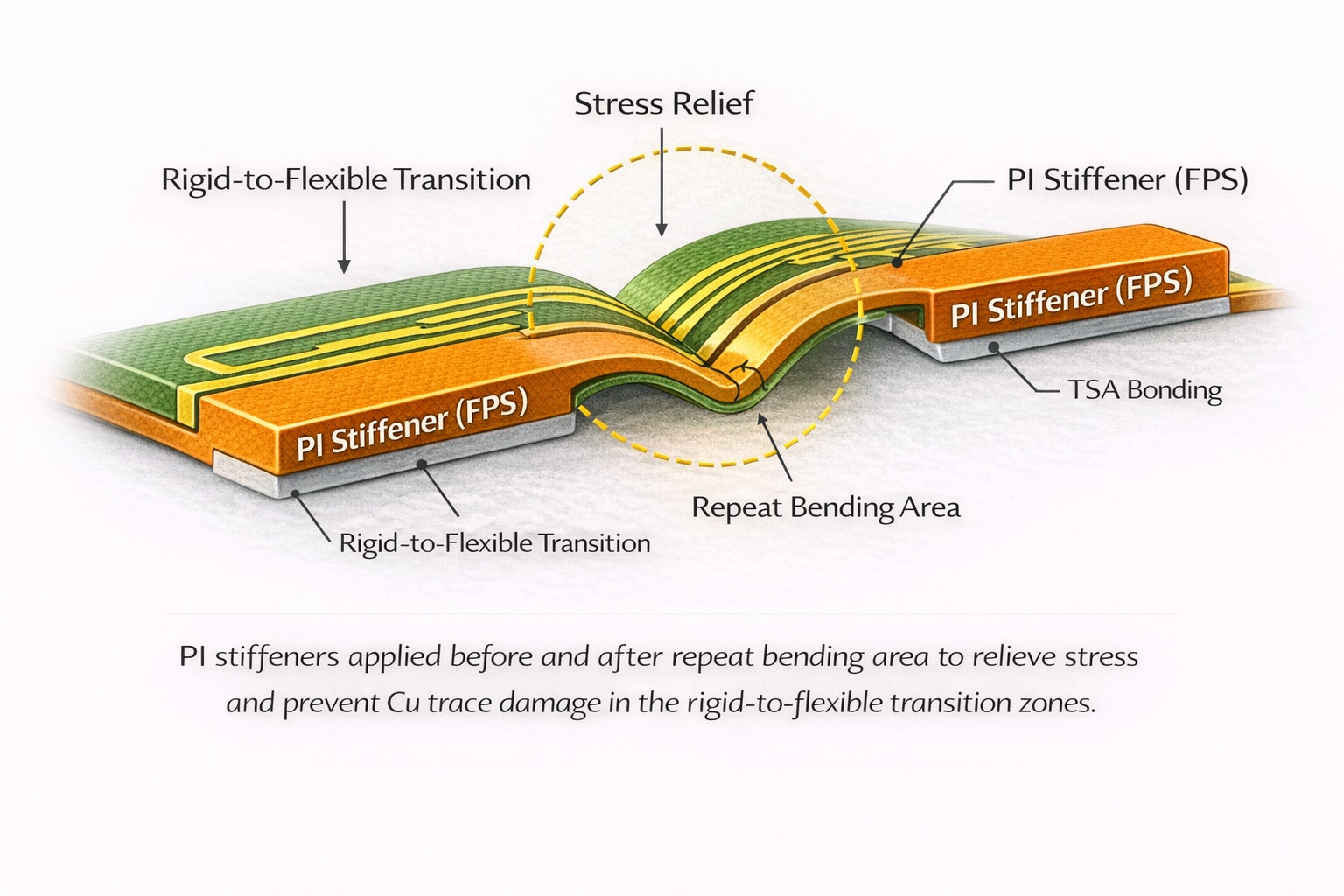
Representative FPC cross-section illustrating PI Stiffener (FPS) placement before and after the bending area to relieve stress at rigid-to-flex transitions and improve long-term bending reliability.
FPC Stiffener Design Considerations :
Key Engineering Factors When Applying a Polyimide (PI) Stiffener to FPCs
- Stiffness Requirements - Select PI stiffener material and thickness based on the level of flex suppression required, ensuring sufficient rigidity without inducing stress concentration.
- Area Coverage - Optimize stiffener footprint to reinforce critical regions while minimizing added weight and impact on assembly processes.
- Component Clearance - Incorporate cutouts and openings to accommodate connectors and components, accounting for adhesive flow and lamination tolerances.
- Routing & Interconnections - Position stiffeners to avoid interference with signal routing, vias, and interconnections across FPC layers.
- FPC Stack-up Compatibility - Match stiffener rigidity and adhesive chemistry with FPC layer count, dielectric thickness, and substrate materials.
- Adhesive System Selection (TSA vs. PSA) - Thermoset adhesives (TSA) are preferred in high-reliability designs where strong bonding strength, long-term stability, and resistance to temperature cycling are required. Reworkability is intentionally sacrificed in favor of mechanical integrity and durability.
- Assembly & Process Robustness - Stiffener design should support stable lamination, accurate alignment, and consistent bonding without compromising automated handling or inspection.
- Thickness & Weight Constraints - Total thickness after stiffener attachment must meet Z-height limits; lightweight materials are preferred for portable devices.
- Environmental & Thermal Reliability - PI stiffeners and TSA adhesives must withstand extended temperature cycling, humidity, chemical exposure, and aging without degradation or bond strength loss.
- Thermal Management Requirements - Select insulating or thermally conductive stiffeners based on component heat dissipation needs while maintaining electrical isolation.
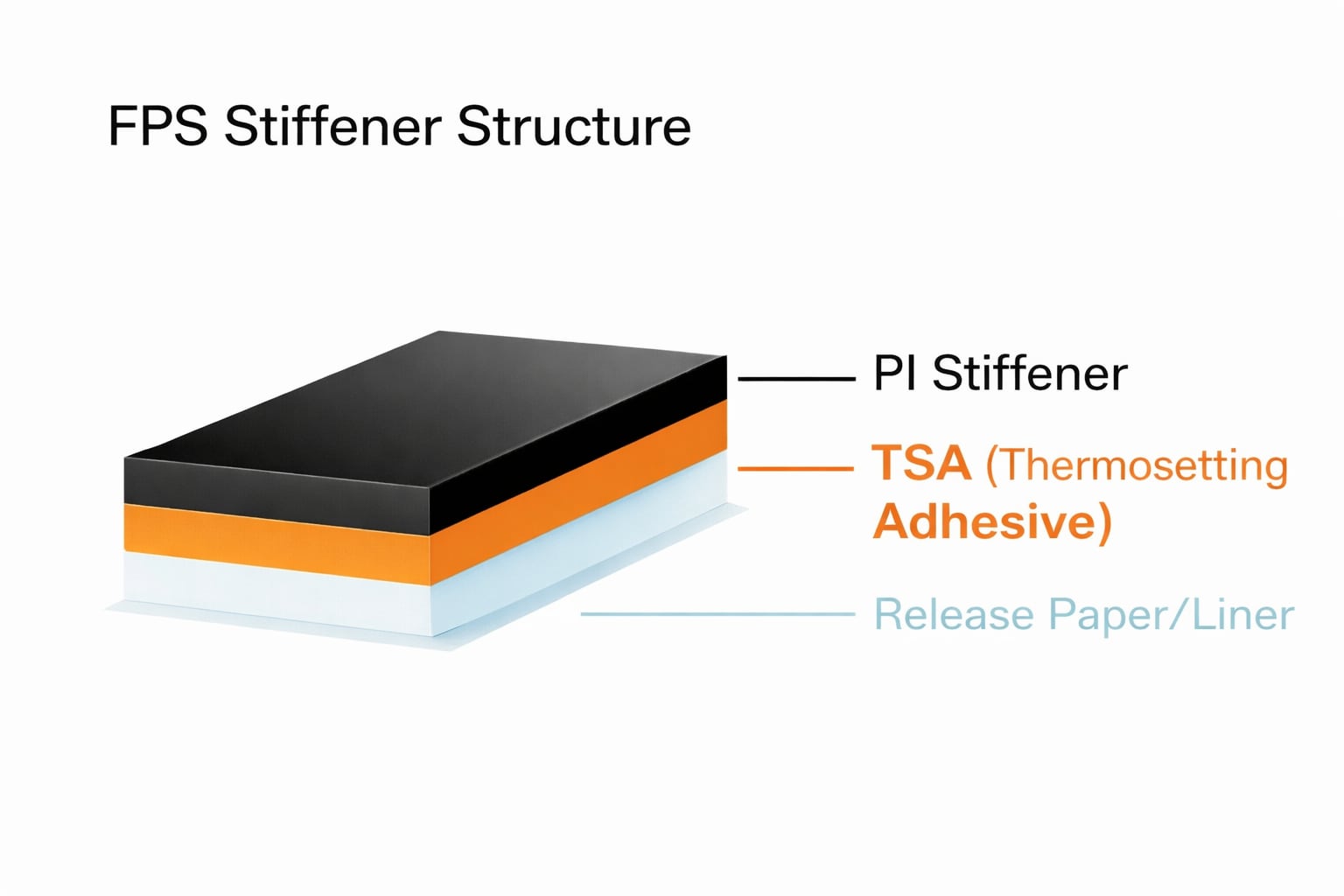
FPS Stiffener Structure:
Top Layer : High Dimensional Stability (low shrinkage) Polyimide film (1mil~6mil)
or
High Thermal Conductivity PI Film (1mil~5mil)
Middle Layer : High Bonding Strength Thermosetting Epoxy Adhesives (25um/35um) - Room Temperature Type
Bottom Layer : Release Paper / Liner (135um)
Key Properties:
High Bonding Strength: 25~30N/10mm (to PI Film) by using 90° peeling test way.
- Enhanced Mechanical Strength: Reinforces critical FPC areas
- Improved Assembly Reliability: Supports ZIF connectors and soldering zones
- Controlled Flexibility: Prevents excessive bending and deformation
- Material Versatility: Compatible with PI, PET, FR-4, and metal stiffeners
- Good storage condition: It can keep good functionality at room temperature for 4~5 months
- Design Flexibility: Available in customized shapes and thicknesses
- No bubbles, wrinkles, scratches, foreign matters, and glue squeeze-out.
- RoHS & REACH SVHC compliant, meeting all current EU environment mandates.
- UL 94 V-0 , VTM-0 Certified.
Typical Applications:
Connector Reinforcement - ZIF / LIF connectors, Board-to-board or FPC-to-PCB interfaces
Component Mounting Area Support - ICs, sensors, power components, Prevents bending-induced solder or pad failure
Display modules (OLED / LCD / touch modules) Interfaces - Display FPC tail reinforcement, Touch panel or camera module connections
Wearable & Portable Electronics - Smartwatches, fitness trackers, AR/VR devices
Automotive electronics - Instrument clusters, ADAS camera modules, In-vehicle displays and control units
Camera & Sensor Modules - Image sensors, biosensors, optical modules
Industrial Devices - Industrial control panels, sensors and diagnostic devices
High-Density / Fine-Pitch FPC Designs - Fine-pitch traces and connectors, Multi-layer FPC constructions
Localized Bend constraints
FAQs
- What is the main function of an FPC stiffener? It provides localized mechanical reinforcement at connectors and component areas to ensure dimensional stability during assembly and use.
- How do I choose between TSA and PSA for an FPC stiffener? The choice depends on bond strength, reliability requirements, and manufacturing process. TSA (thermosetting adhesive) is preferred for high-reliability applications requiring strong permanent bonding and resistance to thermal cycling. PSA (pressure-sensitive adhesive) is typically used when precise positioning, automated placement, or limited reworkability is required.
- Can an FPC stiffener assist with heat dissipation? Yes. Thermally conductive stiffeners can help spread heat under high-power components and reduce local hot spots.
- Can multiple small stiffeners be used instead of one large stiffener? Yes. Multiple localized stiffeners are often used to balance reinforcement, flexibility, and weight.
- What fabrication tolerance is recommended for FPC stiffeners? Typical tolerance is ±0.20 mm; ±0.1 mm or tighter is recommended near connectors or alignment-critical areas.
- What is the typical thickness of an FPC stiffener? Plastic or PI stiffeners are typically 0.075–1.0 mm thick, while metal stiffeners can be thinner due to higher rigidity.
Application Case:
I. PI Stiffener FPS for FPC | Reinforce Flex Circuits with Precision & Stability
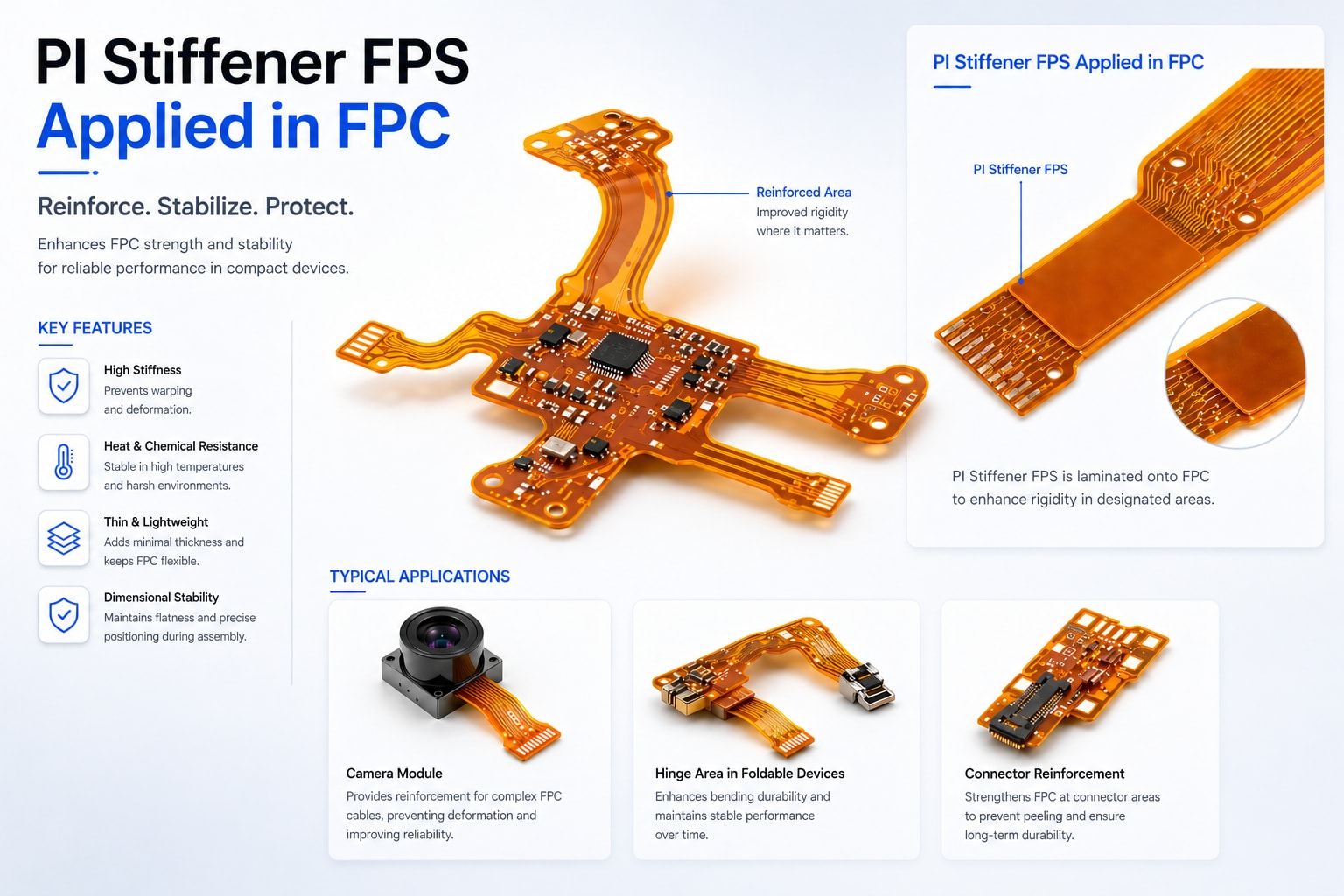
PI Stiffener FPS enhances the structural rigidity and dimensional stability of FPC, enabling reliable performance in compact and high-density electronic devices. Ideal for camera modules, foldable hinges, and connector reinforcement.
.webp?d=480x480)
Reinforcing FPC designs for demanding mechanical conditions?
Contact us to discuss PI Stiffener (FPS) solutions engineered for your FPC structure, bending profile, and long-term reliability requirements.
.webp?d=480x480)
